
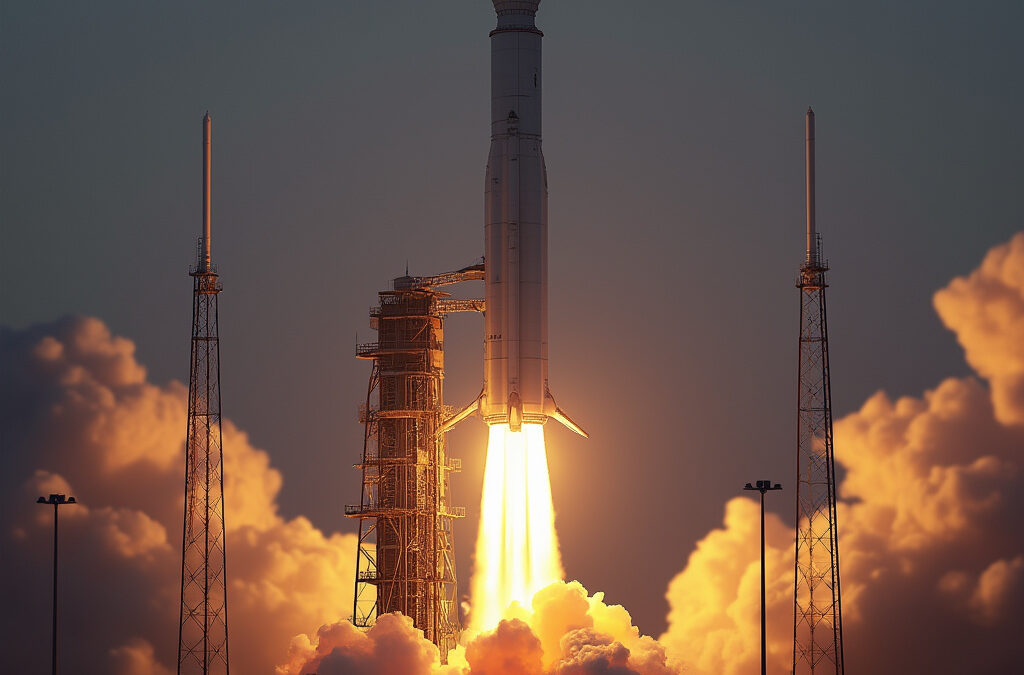
SpaceX Aims to Overcome Starship Setbacks With 10th Flight Test
On August 26, 2025, SpaceX reached a pivotal milestone with the tenth test flight of its Starship-Super Heavy rocket, marking a significant step forward in reliability and reusability after a series of challenges earlier in the year.
Liftoff occurred at 7:30 p.m. ET from SpaceX’s Starbase in Texas, following delays caused by technical issues and unfavorable weather conditions. The rocket, comprising the Super Heavy booster (Booster 16) and the Starship upper stage (Ship 37), stands as the most powerful launch vehicle ever constructed, designed for full and rapid reusability.
SpaceX’s primary objective for this mission was to push the rocket’s limits and gather critical data to refine future designs. According to SpaceX, “Every major objective was met, providing critical data to inform designs of the next generation Starship and Super Heavy.”
The flight marked a turning point for the Starship program, which had faced setbacks, including the destruction of a previous test vehicle (Ship 36) and three consecutive catastrophic failures earlier in 2025. The successful test demonstrated SpaceX’s ability to adapt and improve its technology rapidly.
The Super Heavy booster successfully boosted the Starship into the lower atmosphere before executing a controlled descent, splashing down in the Gulf of Mexico. Notably, it compensated for a deliberately shut-down landing engine, showcasing its robust systems.
The Starship upper stage achieved a sub-orbital trajectory, a milestone not reached in the three previous test flights. Despite partial melting of a control flap and damage to a protective engine skirt during re-entry, the vehicle survived much of its journey intact.
During the flight, the upper stage briefly re-ignited one of its six Raptor engines in space, demonstrating a key capability for future operational missions. For the first time, Starship also deployed eight dummy Starlink satellite simulators, testing its payload deployment mechanism.
Cameras and sensors monitored the performance of the heat shield tiles, with some intentionally removed to stress-test the structure’s ability to withstand re-entry heating. The flight concluded with a controlled splashdown in the Indian Ocean off Western Australia, 66.5 minutes after launch. While the vehicle broke up upon impact, this was considered a routine outcome.
SpaceX team members celebrated the series of successful events during the 66-minute flight, marking a stark improvement from earlier tests where the upper stage often failed within ten minutes, ending in explosions or breakup on re-entry.
The mission underscored SpaceX’s experimental approach to testing, with systems intentionally stressed or partially disabled to collect performance data. This philosophy has allowed the company to adapt rapidly, as seen when the destruction of Ship 36 on the test stand forced a quick transition to Ship 37 with minimal delay.
The success of Flight 10 strengthens SpaceX’s credibility and technical confidence, setting the stage for more robust tests leading towards operational missions and future crewed spaceflight. While a mid-air launch gantry catch has not yet been attempted, the controlled splashdowns validate the systems needed for eventual booster and ship return and reuse.
Starship and Super Heavy are central to SpaceX’s vision of a fully reusable transport system, enabling affordable and sustainable space travel beyond Earth orbit, including Mars colonization. This tenth flight represents a substantial leap forward in reusable rocket technology, ending a string of setbacks and gathering vital data to shape future designs and objectives.
SpaceX Aims to Overcome Starship Setbacks With 10th Flight Test
On August 26, 2025, SpaceX reached a pivotal milestone with the tenth test flight of its Starship-Super Heavy rocket, marking a significant step forward in reliability and reusability after a series of challenges earlier in the year.
Liftoff occurred at 7:30 p.m. ET from SpaceX’s Starbase in Texas, following delays caused by technical issues and unfavorable weather conditions. The rocket, comprising the Super Heavy booster (Booster 16) and the Starship upper stage (Ship 37), stands as the most powerful launch vehicle ever constructed, designed for full and rapid reusability.
SpaceX’s primary objective for this mission was to push the rocket’s limits and gather critical data to refine future designs. According to SpaceX, “Every major objective was met, providing critical data to inform designs of the next generation Starship and Super Heavy.”
The flight marked a turning point for the Starship program, which had faced setbacks, including the destruction of a previous test vehicle (Ship 36) and three consecutive catastrophic failures earlier in 2025. The successful test demonstrated SpaceX’s ability to adapt and improve its technology rapidly.
The Super Heavy booster successfully boosted the Starship into the lower atmosphere before executing a controlled descent, splashing down in the Gulf of Mexico. Notably, it compensated for a deliberately shut-down landing engine, showcasing its robust systems.
The Starship upper stage achieved a sub-orbital trajectory, a milestone not reached in the three previous test flights. Despite partial melting of a control flap and damage to a protective engine skirt during re-entry, the vehicle survived much of its journey intact.
During the flight, the upper stage briefly re-ignited one of its six Raptor engines in space, demonstrating a key capability for future operational missions. For the first time, Starship also deployed eight dummy Starlink satellite simulators, testing its payload deployment mechanism.
Cameras and sensors monitored the performance of the heat shield tiles, with some intentionally removed to stress-test the structure’s ability to withstand re-entry heating. The flight concluded with a controlled splashdown in the Indian Ocean off Western Australia, 66.5 minutes after launch. While the vehicle broke up upon impact, this was considered a routine outcome.
SpaceX team members celebrated the series of successful events during the 66-minute flight, marking a stark improvement from earlier tests where the upper stage often failed within ten minutes, ending in explosions or breakup on re-entry.
The mission underscored SpaceX’s experimental approach to testing, with systems intentionally stressed or partially disabled to collect performance data. This philosophy has allowed the company to adapt rapidly, as seen when the destruction of Ship 36 on the test stand forced a quick transition to Ship 37 with minimal delay.
The success of Flight 10 strengthens SpaceX’s credibility and technical confidence, setting the stage for more robust tests leading towards operational missions and future crewed spaceflight. While a mid-air launch gantry catch has not yet been attempted, the controlled splashdowns validate the systems needed for eventual booster and ship return and reuse.
Starship and Super Heavy are central to SpaceX’s vision of a fully reusable transport system, enabling affordable and sustainable space travel beyond Earth orbit, including Mars colonization. This tenth flight represents a substantial leap forward in reusable rocket technology, ending a string of setbacks and gathering vital data to shape future designs and objectives.
Conclusion
The tenth test flight of SpaceX’s Starship-Super Heavy rocket represents a significant milestone in the program’s journey toward reliability and reusability. Despite earlier setbacks, including the loss of Ship 36 and three consecutive failures, SpaceX demonstrated its resilience and ability to adapt. The successful flight showcased the robustness of the Super Heavy booster and the Starship upper stage, achieving critical objectives such as sub-orbital trajectory, payload deployment, and controlled splashdowns.
The data collected from this mission will be instrumental in refining the design of future Starship and Super Heavy vehicles, bringing SpaceX closer to its vision of a fully reusable transport system. This achievement not only strengthens SpaceX’s technical confidence but also paves the way for operational missions, crewed spaceflight, and ultimately, humanity’s ambition to explore and settle beyond Earth.
Frequently Asked Questions
Was the 10th Starship test flight successful?
Yes, the 10th test flight of the Starship-Super Heavy rocket was successful. It met all major objectives, including achieving a sub-orbital trajectory, testing payload deployment, and demonstrating controlled splashdowns.
What is the significance of reusability in the Starship program?
Reusability is central to SpaceX’s vision of making space travel affordable and sustainable. The Starship-Super Heavy system is designed for full and rapid reusability, enabling multiple missions with minimal turnaround time and reducing the cost of access to space.
What was the role of the Raptor engine in the 10th test flight?
The Raptor engine played a crucial role in the 10th test flight. The upper stage briefly re-ignited one of its six Raptor engines in space, demonstrating a key capability for future operational missions. This test also involved intentionally shutting down a landing engine to showcase the system’s robustness.
What’s next for the Starship program after this successful flight?
With the success of the 10th test flight, SpaceX is expected to conduct more robust tests leading toward operational missions. The next steps may include attempting mid-air launch gantry catches, further refining the booster and ship return systems, and preparing for crewed spaceflight.
How does this milestone impact SpaceX’s goal of Mars colonization?
The success of the 10th test flight brings SpaceX closer to achieving its goal of Mars colonization. A fully reusable Starship-Super Heavy system will enable affordable and sustainable space travel, making it possible to transport both crew and cargo to the Red Planet and beyond.